Thursday, 18 October 2012

The Highs of Life

"Do not follow where the path may lead. Go instead where there is no path, and leave a trail"

Mission climb-the-highest-mountain in Greece is officially checked off the list of things to do. Mount Olympus is rightfully the home of the twelve Olympian Gods of the ancient world, with the highest peak being Zeus’ throne, called Mytikas. We decided to pay him a visit, it was one we will never forget.
As with all our fun-filled CYA trips, we started bright and early on Friday morning. No ferry ride this time, but we were compensated with a six-hour bus ride instead. The intention to finish some homework soon turned into a five-hour ‘nap’, with no regrets. Stopping along the way, we gobbled down a delicious tavern lunch of protein and carbohydrates to gear up for the hike up. To start the trek, we had to start from the village of Litochoro (pronounced Lee-tho-huro; this desire to start spelling things out first in Greek before English might prove to be a problem upon return): the village of the Gods.
"Do I look at the ground or do I look up?!"
As to be expected of a mountain, the hike was extremely uphill. Just when you thought there could be no more steps steeper than the ones you just dominated, there comes another set, just as impending as the ones before. It took every strain of effort to continue the three hour climb. Our goal was to reach a refuge shelter that was located 2/3 of the way up.
We were lucky to have two interesting guides accompany us along the climb. Cristas, “and his friend Yannis” were the source of much amusement and lightheartedness throughout the trip. With jokes about how much further we had till we reached the end, to pretending we were lost, to constantly reminding us about the single room we would share in the shelter, they were a riot. Apart from the fact that it was nearly impossible to take them seriously, they did come to the rescue over the weekend, producing “magic medicine” (a.k.a. magnesium) to make the knees stop aching, and Band-Aids galore after what I think was a graceful slide down a slope of gravel.
Yes we’re adults, but not once did that stop the twenty of us from coming up with silly ways to pass the time during the climb – I discovered my lack of technical knowledge of anything to do with entertainment. Needless to say there was no need to anyway: the view was breathtaking. It was a world away from Athens, and basically a world away from everything. It was delightful to hear the water from a spring while wandering through the forest and stare intrepidly at the avalanches near the bottom, and to gaze across the clouds and past the village to see the sea once we were higher up. The rush of standing along the cliff-side along the top is unparalleled, and the more of the view we absorbed, the more we yearned to take in.
That same day, we finally (really, there was a point it seemed unlikely we would make it up there) reached the shelter at 8.30pm. What time did they stop serving food? 9.00pm. What time was lights-out? 10.00pm. We were a group of tired, hungry, and slightly delirious college students. It was a miracle we managed to squeeze into the lobby, which doubled as the place to order food, take off our shoes to switch into required sandals, and relax into the atmosphere. It was cozy, with two fireplaces that we quickly claimed as ours, long tables to sit at with other adventurous souls from around the world, and one huge room we all had to sleep in. The best part of the night however, was stepping outside into the chilly mountain air to see the stars.
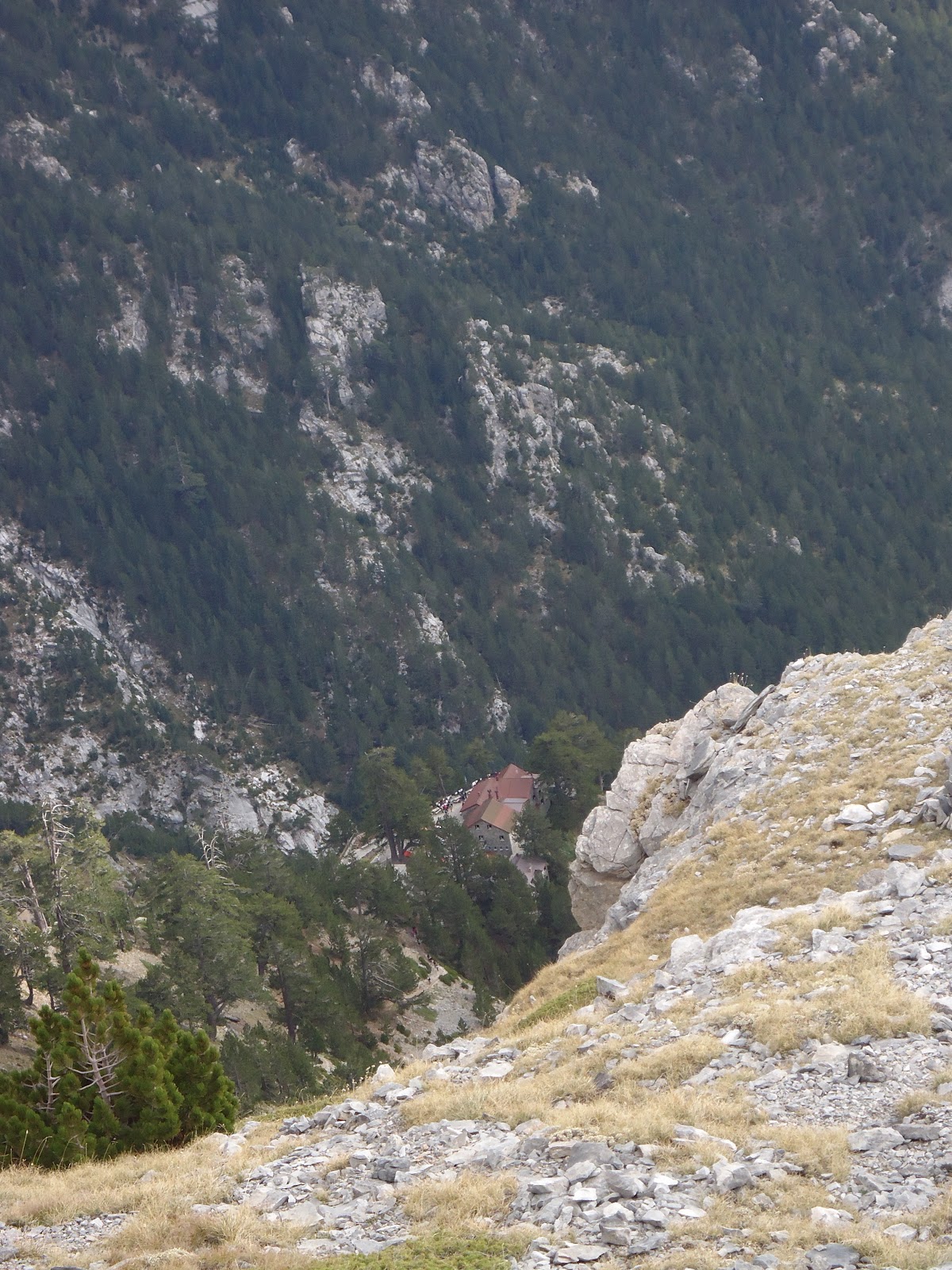
The shelter that (almost) never was
The sky was so dark it was almost frightening, but the stars were as clear as crystal. Each shone proudly, yet none outdid the other. It was perfect harmony, and it was the magical highlight of the trip. Shooting stars were all over the place, and the more you focused, the more stars there were that revealed themselves, seemingly only to you. It was one of those powerful moments that fill you with an enchanting sense of serenity.
Early to bed, and early to rise (kind of), we geared up over a hearty breakfast by the fireplace. We still had another two hours to reach our goal. We were unable to hit the very top, because that requires climbing gear and technical experience. We settled for the base of Zeus’ throne. Already above the clouds, we went higher and higher, passed by a few donkeys who were probably smirking at our valiant efforts, and crossed the part of the trail that required three meters of distance between each other to account for and dodge stones chucked down from the wild goats who reside above. With fewer stops than the day before and the sun warming the cool air and edging us on, we made our way to the peak.
We approached the end in high spirits, full of immense gratification. We could see so far beyond, and were surrounded by so many different landscapes and other mountain tops. At this point, we could also look across to another peak: one with another refuge – at the same altitude of 2,100 meters. We even saw people making their way towards it, as well as some who were ascending to the top of Mytikas. Right next to it, there was a tiny Church – it is said that underneath the Church was a pagan temple from Ancient times, and when it was destroyed the Church was built atop it. I’m not sure Zeus was too happy about that.

Zeus' lair; not a bad place to call home
It felt so rewarding to be so wholly immersed in nature and have completed the strenuous endeavor. We spend quite a while up there, and I took off to a higher point above the rest of the group, and –to add to the entire cliché – meditated in front of an alcove on the cliff. When it was time to say goodbye and make our way back to the shelter, we took our final pictures and tried to imprint the view permanently in our memories. The journey down didn’t take long, and the change in terrain was a nice reprieve for our tender leg muscles. We literally flew down the mountain, and after a quick stop at the refuge to pick up our bags and eat lunch, we descended down Mount Olympus, to return home to Athens.
The realization of just much we covered hit us on the descent down. We appreciated how much we actually climbed the day before, and wondered at how we navigated it in semi-darkness. It was a relatively quiet hike down, as we all reflected on various personal aspects. It was a great weekend get-a-way. Even though we hadn't showered the entire time (or for that matter, did we have running water for the whole trip), even though we paid too much for comfort food at the lodge, and even though we anticipated the soreness and body pains for many days to come – we had an absolutely exhilarating time. We bonded over fruit and nut snacks, over sleeping in the same room, over sharing a water bottle to brush our teeth, and over taking turns to turn around slowly in front of the fire. I told the stars I would be back one day, to make it to the very top, and that they should please continue shining ever-so-brightly, and I decided I was inspired to stay somewhat in better shape so that it wouldn't be as painful the next time around.
It still will be though; mai doulevees (are you kidding me)?
With the weekends being packed with intense travelling and creating moments that will live in my heart forever; the weekdays feel very different. With five full classes, tutoring twice a week, and cooking dinner every night, there isn't much time for much else. Throw in a demonstration every now and then, and it is impossible to tell I’m not local (putting aside some other very significant giveaways; but really, who really notices those anyways?).
Given the political and economic atmosphere this is prevalent now, the nation is gripped by a multitude of attitudes and feelings. Conservatives, liberals, communists, socialists, and everyone else – they all have something to say. Their voices crave to be heard, and the people just want to be taken as worthy of acknowledgement. All protests usually take place in the heart of the city: Syntagma Square. It is the scene most prominently featured in the news, the area all the tourist buses stop first, the park with the best street acts, and it has the kiosks with the best postcards. It also happens to be a seven minute walk from our neighborhood.
On one sunny day last week was one such protest. It was the day Angela Merkel, the German Chancellor was to visit the Greek Parliament for “some talks”. The Greeks are not too happy with Germany’s involvement in their economic affairs, and as with other things that they are not happy with, they naturally called to demonstrate against it. The whole city follows unofficial procedures and know-how on these days, with public transport being disrupted and stores closing down. Everyone who is anyone shows up, whether for solidarity and support or to witness the spectacle and observe.
Angela Merkel's welcome party
After lunch we walked across the National Gardens to the Parliament building, passing by civil police officers (armed with their handsome faces and semi-automatics) who were stationed at intervals leading up to the Square. We hit the mass of people almost immediately and meandered about. The whole thing was like a show: there were people selling food and souvlakis, tourists taking pictures and gaping open-mouthed, college and high-school students hanging out and missing classes, locals shopping and wandering in the commercial district beyond, and a sprinkling of media crews here and there, poised and ready for anything.Mostly, there was just a lot of people.
All part of some party or another, they milled about and chanted slogans against “the reforms” and discrediting the “austerity measures”. We happened upon a group that seemed to be signifying Merkel’s visit as the “reoccupation of Greece by Germany”, mocking the German takeover of Greece in the 1940s. They did so by donning the garb of Hitler, wearing the Nazi swastika, and burning the Nazi flag atop a barricade beside the Parliament. Yes, it was overhyped, overdramatized, and overplayed. What was really blown out of proportion though, was the response of the frenzied media who took this to a whole new level of journalistic license, describing them in ways that is an unfair depiction of these peoples’ actions. They hurt nobody, and demanded no obligatory support. They were simply citizens voicing their views and hoping to have people take notice of them.
Old ladies dressed in their Sunday best, and young toddlers in strollers; the media never portrays these peaceful demonstrators. Rather, they focus on those few radicals who storm the streets every once in a while throwing nondescript objects into the crowd. They focus on the lines of police wearing protective gear and shields (which they use so that they don’t get hit with things like tomatoes, eggs, and plastic bottles). They focus on the things that aren't the focus of these demonstrations. The focus is the hearts of these people; their hearts which are invested in this beautiful country which they call home.
They simply don’t appreciate the idea of other European Union countries dictating how Greece should function, nor do they look favorably upon the prospect of having to pay for the mistakes of the Government. People follow the happenings from all over the globe, the seeming “violence and unrest” in Greece; really, they should be following the “despondency and distress” that arise from the myriad of voices and perspectives that make this diverse country as special as it is. The tear gas from the police at the end of every demonstration has now become part and parcel of the whole performance, acting as a finale to signal the end of the proceedings. It is not the lethal poison that people assume, it is not intentionally thrown towards people, and it usually occurs after the crowds have already dispersed. Sometimes it is even the police who will dress up as rioters and “provoke” the police so as to conclude the day’s proceedings.
Scared? Not in the slightest
This is all not to say that it is not a big deal. These demonstrations are one of the most significant aspects of living in Athens, a real insight into the way of life here. Things can get out of hand, people do get hurt, and most often no perceivable resolution comes as a result of them. What is important is to legitimately represent that: in order to understand a demonstration, one must participate in a demonstration, and not simply read about it a few hours later in a different hemisphere and judge what transpires.
For now, I will settle with going to yet another protest tomorrow to see and be seen as an interesting way to end this week of academic studiousness, after which is the weekend’s trip to Meteora and Metsovo to see world famous monasteries and the battleground Thermopylae. Just another week in the life of an Athenian – the life of this Indian-born, America-bred Athenian.

Friday, 5 October 2012

Beauty is in the Eyes of the Beholder


"If you don't know where you're going, any road will take you there"
Call it what you will: according to tradition it is Kallisti (“most beautiful”), in antiquity its name was Thira, and ancient times knew it as Strongili (“rounded”).
I will settle for calling it Paradise.
Modern Greeks (as well as the rest of the world) revere the famed Island of Santorini for its tumultuous geological history, for the views along the cliffs around the edge of the coastline, for the unique early civilizations that thrived once upon a time, and for the hearty cuisine that makes the mouth and heart melt.
Several of us took the trip out to this enchanting island, a trip which started with an eight hour long boat ride there. For most of Friday morning we relaxed on the deck, grappled with mild sea sickness, and tried to accomplish a little work before arriving at our destination. Late afternoon saw us debarking to the small port of Athinios where we haggled with local bus drivers, but finally figured out which one would take us to our hotel. Up the cliff and around the bend was the tourist-populated town of Fira. Our hotel, King Thiras Hotel, required a hike up a small hill, overlooking the Old Center of the Island; it was quite quaint with the conventional white-washed walls and blue wooden frames that adorn the country-side of most Islands in Greece. The couple who owns and runs the hotel were ever so helpful, driving us to and from the bus stop, booking our tour trips, giving us information about archaeological site and museum hours of operation, and serving us Greek yogurt for breakfast every morning. I was lucky to listen to the owner’s stories about his time in the navy 50 years ago when he travelled around the world “at least three times”, and he also bought brown bread for breakfast just for me thereafter.
Oia is the most famous village in Santorini; its picturesque alleys, stylish restaurants, and multi-lingual shop owners have visitors eating out of the palms of their hands. The element that trumps them all though, is the sunset. People flock from all over the world to visit this impressive cliff-side view of one of nature’s best shows. Standing atop a castle-like fortification, while snagging the perfect picture and feeling at one with the sun, sea, earth, and wind all around you, was priceless. The night was made complete with a perfect dinner at a high-end restaurant that jutted out on a cliff above the water. While wandering around the town a little while longer, we stopped to talk to some locals and practiced our Greek, which is slowly but surely getting better (or so we like to think), and spontaneously indulged in mint and chocolate gelato.
Postcard ready, with hardly any effort
It was an early night for us, to pace ourselves for the next couple of nights ahead. After a late breakfast the next morning we decided to explore the little town around our hotel. There were countless shops, museums, restaurants, and best of all, free samples of caramel and sesame-covered peanuts. After gazing our fill at little antique stores, we found our way down the two kilometer of steps that meandered down the cliff to the water. Accompanying us were hundreds of donkeys for tourists to ride on; species indigenous to the island. We were brave, but not that brave. We settled for simply patting them along the way. Once at the port, we loaded ourselves onto an early 20th century pirate ship look-a-like. With the sail and mast guiding our way, we arrived a short while later at the active volcanoes we were so eager to explore.

We learned about three craters, and walked around the edge of the only one still active. The colour of the ash determines the age of the lava and the volcano; therefore the darker the ash, the fresher the lava deposits. The largest crater that was still active had small ‘ovens’ around it, in which placing your hands will almost roast them to bits. The temperature is significantly higher (which, considering the already hot day, was remarkable, and a little uncomfortable) and you can definitely smell the sulphur and smoke being emitted from the mouth of the crater. The stories about the eruption of the volcano that we learned in class coincided with the tour guide’s information: over many centuries the continuous eruptions and activities of the volcano significantly changed the shape and layout of the island. It went from being a circular block of land almost forever ago to now being a huge caldera, giving one an absolutely spectacular view of the other end of the island from either end. The violent explosions were massive, with ash coverings measuring up to 150 feet high.
After the walking tour we were taken in the same boat to the other side of the small area of land into the hot springs. The temperature was absolutely perfect, not too warm, but just warm enough. We dived right in, directly from the boad. Slides and ladders from the boat were unleashed, as we swam around and had a drink by the floating bar. Flawless way to end a visit to an active volcano? Me thinks yes. That, and the lovely breeze flying through our hair on the way back.

We are energetic, youthful souls. I always take the stairs without hesitation. I will hike up almost anything (if there is sufficient shade), and I will rough it up from time to time.
But yes, we took the cable cars back up the hill. It was worth it – for the time saved, for the hot flushes that were spared, and for the view as we zoomed back up to heaven. My falafel radar kicked in almost immediately and I found an adorable little Mediterranean take-out place with the most delicious falafel I’ve had in a while. Also with handsome and funny servers, who expertly yielded to my request for “pola lahanika, parakalo’ (lots of vegetables, please) and assumed I would like the extra hot spicy sauce they have because I am “from the India, where you eat too many spicy things”. Assumption much appreciated, so much so that I returned to lunch there the next afternoon too.
Beautiful craftsmanship - blue as blue can be
That same afternoon, we weren't quite through yet. We caught a bus to Akrotiri, which is an ancient archaeological site. It is said to have extensive Minoan (from Crete) influence architecturally, artistically, and culturally. It did not disappoint; the site was completely indoors and had modern walkways through the rooms and ruins of the city. There were building three stories high – built back around 1400BC. Too many pots to count, and so many protrusions from the walls that I stopped taking pictures very quickly – it was mesmerizing and probably one of my two favourite sites I've visited so far. I have become quite fond of walking through these things while fancying myself part of whatever nobility existed back then. I would have enjoyed being a princess and living in the large ‘palaces’ (correction, the people who know better know to call them ‘Large Administrative Centers’, says my wonderfully witty archaeological professor).
That was my room. In my previous life. As a princess in Akrotiri
We then walked all of ten minutes to get to the Red Beach, watch people cliff jump (I am still stunned that this happens in real life), and walked back to the main center of Akrotiri to find an old Venetian tower. This old Venetian tower held the secret to a wonderful night. We visited an alumnus of CYA who studied here 20 years ago. She gave up her life in the States and moved to Athens, worked for a bit, met her husband, and they gave it all up again and moved to Santorini. They both love history and music – so what better way to combine their passion than to resurrect to glory this ancient tower once occupied by the Byzantines, the Romans, the Greeks, and now them? Oh, and just to make things interesting, they dedicated their efforts in bringing back the importance of the Greek bagpipe. Called the Sambuca, it has parts from a goat, a sheep, and a cow. It sounded marvelous and very enchanting.

Sitting there and marveling at her husband’s musical ability on the instrument wasn't sufficient though. He gave us each a percussion instrument and soon we were making some pretty decent music. We learned so much about music, history, and life. They had such a zest for life, and were inspiring in the way they described (albeit a cliché) how happiness should dictate your decisions in life. The night continued after the performance at her favourite taverna in town. Round after round of appetizers, we did our newly honed Greek appetites proud. We graciously accepted grapes to take home (mostly because I powered through them so fast I think the owner thought I was fruit-deprived all my life) and hailed the bus down as it drove by, from our seats at the table. The long bus ride home offered new views of the island, and I persevered with enthusiasm until I crashed upon my bed at King Thiras Hotel as soon as I stepped foot inside.
Our last day was simultaneously and upbeat yet low-key one. We visited the archaeological and history museums and spent a long time supplementing our visit to the ancient site the day before. It was enjoyable to examine the jewelry, potters, and tools the excavations produced. The last exhibit was a decent sized, completely golden bull with its consecrated horns. Anthropologists are still unsure about the ritual activities and events leading up to the volcanoes of the people of ancient Akrotiri, but nevertheless they produced many diverse artifacts. The last stop was the Santozeum, a private collection of frescoes painstakingly pieced back together by many international teams, and lots of complicated technology. Frescoes are a technique of mural painting on fresh limestone. It is very complicated, and disastrous to get wrong. The Minoans fashioned plenty however, with scenes of nature, general people in daily life, war scenes, conquests and exploits, ritual and cult activity, and some purely decorative masterpieces. The museum was located right at the edge of the cliff, providing a serene experience. After gaining as much insight as I thought possible, we made our way back.
Found among the ask remains, perfectly intact, possibly ritualistic?
Armed with our bags and falafel for a quick lunch, we waited for our ship back that almost never came. Not that it would have been a bad thing to be stranded there; that should count as a legitimate excuse for an absence, right? Once finally aboard, we settled in to study what little we could, play many rounds of intensely heated Mafia and fast-paced Skip-Bo. I find it incredible that I’m still learning more about America even here, 5000 miles away from campus. I’m learning even more about Greece though, every single day; I met a group of elderly couples on the boat who talked to me about studying abroad from America, living in India, and adjusting in Athens. The interruption from studying was welcome, as they shared their snacks and described how they all used to teach at Universities before, but now are just travelling around all the Aegean Islands, marveling at all they missed out on in life thus far.

Indeed you do have the property I'm look for. I'll take it!
All in all, the trip was a tremendous success, and I have pledged to go back one day, if not very soon. There is something about the Island – the locals who love life and live it to the fullest, the water than beckons you to delve recklessly into its depths, the view that freezes your memory in time, and the warmth with which Santorini fills your heart – definitely not an Island to be taken lightly. Though, it probably doesn’t want to be taken too seriously either. Just when you think there is no more space in your heart to fall in love, that is the perfect time to visit and to fall in love with the Island that is Santorini.

Monday, 1 October 2012

An Unforgettable World Away

"All journeys have a secret destination of which the traveler is unaware"   

My schedule threw me off a little before our field trip. On Friday we had our Monday/Wednesday classes and on Monday we had our Tuesday/Thursday classes. It was amusing to say the least when it took me all of seven minutes to remember where I had to be next. It didn’t bother me too much though, because that was the day we would leave for the Island of Crete, one of the most important Island regions off the South West coast of mainland Attica. That evening all 75 of us filled two buses as we headed to the port. This is the closest I have ever been to experiencing a cruise ship, so I’ll admit I did get a little overexcited.


        How could you not though? The carpet was plush and a regal shade of navy blue, the crew was all dressed in sharp black and white suits, and Kenny G was being played the entire embarkation. Our ‘room’ was a set of two bunk beds where we would spend the next nine hours, presumably sleeping to recharge for the hectic week ahead. Of course we slept the whole way through, after a loud and competitive game of cards and a stroll around the decks. I promise I was the only one not tempted to re-enact the Titanic pose at the bow of the ship.


        After a quick breakfast on board at 6am, we were transported from the port of Heraklion, where we docked, to our first archaeological site. This trip was meant to provide us with the actual setting of the ancient Minoan and Early Bronze Age civilizations in the Aegean. We would stand in the sites that were photographed in our textbooks, and visit the museums to examine artifacts we discussed in class. The first site, the palace of Knossos was extensive; it contained a throne room, lots of ‘lustral basins’ (nobody actually knows for what purpose they were used), large storage rooms and a view to rival a penthouse in New York (which I hope to have one day).

        The entire week revolved around visiting other palaces scattered across the Island. We drove a lot, and climbed through ruins a lot, learned more than a lot, and hopefully retained most of it. All of the sites had classic Minoan characteristics of gypsum walls, diverse structuring of the walls and ‘benches’, and a fairly advanced water flow system. The pottery and art was initially simply functional, but as time went on and trade and wealth boosted the economy of the settlements, the transition to a more detail-oriented and elaborate set of patterns is clearly noticeable among the artifacts.
The palace at Knossos - the biggest and grandest of them all
        In school, I learned about the Mohenjodaro and Indus Valley civilizations. In college I learned about the Mesopotamia civilizations. Elsewhere I have learned about the transitions from village farming to settlements. This is the first time I may actually remember enough to teach someone else. To walk the paths the ancient Greeks walked, to wander their corridors and see the sights the way they did saw them; it leaves a lasting impression. I particularly enjoyed my professor’s emphasis about the difficulty of accurately identifying trends and conclusions about ancient life just based on ruins. Often, scholars and researchers are under immense pressure to produce material and results, thus leaving no room for speculation and alternative explanations.

        It was amusing to walk around the sites with tourists from all over the world; learning bits of information not written on plaques in the ground, discovering hidden sections of the site where the crowd could not follow, and mentally correcting the tour guides who had a few of their ‘facts’ wrong. During one visit, I had an umbrella open to shield myself from the sun. My professor made a comment about not knowing we had a tour guide amongst us. I laughed nervously, thoroughly confused as to what he was referring to. Only today did I learn from my friend that I had a few tourists following me for a couple of minutes, thinking I was a tour guide, what with my umbrella (and my natural air of seeming to know everything) – I decided to laugh it off, mostly because of how ridiculous I must have looked. In retrospect it was embarrassing but pretty funny. I wish I had known, and I would have turned around and given them a few stories about the palace.


        The town we stayed in was Heraklion; it was a little commercial, but worth it. Every night we wandered around the endless stretch of stores and little stalls. People were selling things from olive oil infused with walnuts, pepper, or cinnamon, to imitation Prada handbags – we saw it all. We sat down to dinner both nights at tavernas that were different from, but on some level the same as, each other. My favourite one had a different coloured chair at each table, a brightly lit ceiling, and cool Jazz music in the background. Three of us enjoying an early dinner soon (an hour later) turned into a party of about 12. We spent four hours talking about the highlights of our days, the highlights of our lives, and the delicious-ness of the meal. I really did expect the owner to give us a free meal. We settled for free rakhi instead: a strong smelling alcohol special to this Island. Afterwards, I was peer-pressured into trying dark an enormous scoop of gelato, and then I in turn peer-pressured everyone else to walk down the 2 mile pier till the end and back again. It was a gorgeous night, the stars have never been so clear, and the company never quite as endearing. It was a night to remember (not just because of the gelato and the colourful furniture). The next day we stopped for lunch at the beach town of Matala: it had the highest concentration of hippies I have ever seen. Actual, real, hippies.

        The small beach garnered much notoriety in the 60s because of the ‘caves’ along the cliff-side that people took advantage of to smoke in and have their ‘hippie’ moments. Dreadlocks and British accents aside, dots of caves along the coastline and marveling at three shades of the sea were a great way to spend some free time.

Junkie caves along the cliff and waters
        On the penultimate day, we visited a monastery in Arkadi before the end of the day. It was historically a site of great important during the Greek civil war of 1946-1949. The gun powder room was blown up by its own inhabitants to spare them having to surrender to the enemy, and has been unoccupied ever since. My favourite part remains the room in which I saw original 16th-18th century hand-written versions of the four Gospels of the Bible. Also, on the wall was a lock of a woman’s hair found on the ground after the complex was abandoned during the ‘holocaust’. It was as peaceful as one would expect, with pastel shades of pink, delicate flowers that worked wonderfully in my hair, and an altar room engendering thoughtful reflections about life oh-so-long-ago.
Shall we stop and meditate?
        The final day of the trip was mostly non-academic, which we were fine with. The Samaria gorge is a 16 kilometer hike through some of the most gorgeous scenery on can hope to witness anywhere on the Greek Islands. We settled down for an early nightcap in the town of Chania (pronounced Han-ya) where we stocked up on nuts, sunscreen, and enthusiasm for the next day. At 5.30am we ate a large meal (it is disrespectful to call such a meal breakfast, owing to the absurd hour), before settling in for the bus ride to the gorge.

        Throughout the whole trip, breakfast was an event I thrived on.It was almost an unhealthy anticipation. I delighted every morning in an unreasonably large helping of classic, thick Greek yogurt with a huge dollop of honey in it. To that, I add an even bigger dollop of Nutella.  Mmmmmm, it was so yummy. Rich and sweet and creamy, but not too heavy. Well, no, it was heavy, but that never stopped me from eating three bowls full of it anyway.

        With my daily fix of such a bowl full of happiness, I was ready to trek all day. Which we very nearly did. The gorge is a National Park in Crete – created by a small river running between the White mountains – starting at a height of 1,250m and ending on the shores of the Libyan Sea. The unoccupied and almost completely isolated village of Samaría lies exactly halfway through, and is home to the Cretan goat: the Kri Kri. They only exist here, and they are the cutest, most fondle-able goats anywhere, and very familiar with human faces. They ate right out of everyone else’s palm but mine.
Only halfway through. But enough said
        The gorge offers one of the most unforgettable views ever. At the ‘Iron Gates’  of the gorge, the path was only four meters wide, and we walked through the walls that stretched up 300 meters (1,000 feet). This ‘path’ for the most part was just huge rocks and a stream that you had to skillfully maneuver amongst. While you were at it, it was imperative not to talk too loudly, lest a hoard of rocks and stones come tumbling down on you. Luckily they missed us, though very nearly. Rocks are nice when they remain rock-like and don’t budge.

        Four long yet rewarding hours later, we emerged at the other side leading up to the beach. Before getting in the water, customary to tradition in Greece, we spent two hours in a taverna eating, talking, eating, and eating some more. And sleeping a little too (but that was just me). The feeling after completing the hike was an vivid sense of purpose and achievement. It was unlike any other feeling, but one that I could get used to. The variety of the path, the duration of the walk, and the views around every turn were exhilarating. Especially the Cairns that adorned the entire way: historically they have always been associated with an air of mystique and charm. Scottish soldiers would collectively make a pile of stones before leaving off on their journeys, to hopefully return one day and take their stone down. What remained was a heart-rending tribute to those lost forever, but who would be remembered through the generations.

        Now of course it is a way for people to leave their anonymous yet meaningful mark. Of course I made my own pile. To ensure my return? Maybe. To share my happiness and content in the moment? Definitely.


        Crete was an a whirlwind: of learning things beyond what I ever dreamed of learning at ancient sites, of tasting new things and falling in love with most of them, and of awe-inspiring sights never to be forgotten. Most of all, it was a whirlwind of falling in love with the people of the Island, the rich history that engulfed and shaped the culture that exists today, and feeling a renewed appreciation of the interdependent harmony of work and play.


Cairns to last an eternity

Wednesday, 26 September 2012

All the Little Things


"Men go abroad and wonder at the heights of mountains, at the huge waves of the sea, at the long courses of the rivers, at the vast compass of the ocean, and at the circular motion of the stars; yet they then pass by themselves without wondering at all"

       The past two weekends have been filled with exotic experiences and amusingly unforgettable moments. Last Saturday my roommates and I woke up bright and early at 7am to get ready for an exploration of Athens. Determined to walk till we could no longer, we set off for the infamous Syntagma Square. This is the square that the media portrays in the news, the square where the ‘demonstrations’ occur, and the square where you venture to see and be seen. Of course we had to discover its secrets. After getting intentionally lost while wandering through a labyrinth, known more fondly as the National Gardens, we wound up outside the Greek Parliament, overlooking the Square.
       At this point, it is crucial to mention the abundance of police vans all around the city. Not just regular vans – but big chunks of steel with barred windows and 20 policemen to each one. Handsome policemen at that. They are actually a combination of policemen and civil servants; all Greek men have to commit to a year of such civil service at some point. They (don’t) get paid to sit and watch the world go by, ready to end any nuisance that may develop. It is quite intimidating to walk by all of them as they are fully armed and find no awkwardness in staring at you as you stroll (or hurriedly pace) by.
      After passing many more police entourages and watching the changing of the guards at the Parliament building, we walked on. To our delight and amazement, the street leading straight up beyond the square opens up a world of McDonalds, H&M stores, Starbucks, Marks and Spencer, Pandora, and Swarovski. We might as well have been walking down Newbury Street in Boston or the Magnificent Mile in Chicago (or a high-end street in Paris, Milan, or Berlin for that matter). It shouldn’t have surprised us as much as it did, but it was nevertheless a pleasant reminder that we lived in a non-commercial part of town – thus granting us permission to look down upon all the regular tourists.
Balloons anyone? Amidst high-end retailers
       As we settled down at a little Taverna for a light lunch, we were approached by a middle-aged Bengali man selling walking sticks. As I am informed by many professors, there is a significant immigrant population from Bengal who recently arrived in Greece within the past seven years or so. He talked to me in Hindi about “these white foreigners who don’t understand what it is like to be stared at continuously as you walk down the street” and remarked that “it is nice to see such a beautiful Indian face after so long”. I’d be lying if I wasn’t flattered.
       It was not just him either. This past Sunday, a friend and I ventured back to the same area to visit the Athens Flea Market (located in Monastraki, beyond the Square) which is an enormous array of people selling antiques, pocket watches, pirated media, sparkling China, old gramophones, and anything else you can imagine. They are objects that inspires one with visions of 19th century European estates. It was reminiscent of walking through the set of Pride and Prejudice, only, it was artistically Greek inspired. At one point I was behind an elderly Greek lady who inquired about the price of an intricately decorated blue floral plate. I had been eyeing it earlier, and the shopkeeper came out to attend to her. He quoted 40 euro. That was my signal to leave and keep walking. Just as I was about to turn away, I noticed he was Bengali also. He looked at me, and said, “Do you like this?” I redundantly asked him how much it cost, just to be polite. 
       “For you, because you are Indian looking, it is only 10 euro”. Needless to say my friend stuck by me the rest of the day and made us visit nearly every store owned by a South Asian, to see if the same thing would happen again. I ended up not acquiring the plate, out of mere bemusement and confusion.

Greece's largest flea market; one lazy Sunday morning
       Food has been a big source of entertainment for all of us. I get my spices from the Bengali couple who own the store below us (good thing I know the Hindi name for mustard, cumin, and turmeric – instant 10% discount), we shop for groceries at the Alpha Beta supermarket, bread is fresh every morning from the bakery up the street, and chicken is skillfully prepped for us by the butcher: skinned and chopped. Fruits, being the bane of my existence, are full of such sweetness. Along with olives, they remain my favourite food group. Wine has replaced water for many students here, and vinegar is the dressing of choice. I enjoy cooking a late dinner on most evenings for the apartment after my last class at 7pm, and sneaking in a kraitsinyi (whole wheat bread stick rolled in sesame seeds and sunflower seeds) with breakfast. It is mostly the feeling of responsibility and being held accountable for everything I consume that make it seem more important that it really is. Being so far away from the comfort of my school’s delicious dining hall  and home cooked Indian food has definitely taken its emotional toll on me. I am gradually getting used to feeling my way around all the Greek labels though, hoping that the box of couscous is actually couscous and not bird feed.
       With eating taking up so much of my time and interest, exercise has also been relatively easy to commit to. We walk around quite a bit as it is, but impromptu 5K runs around the National Gardens at 9pm are exciting. Athens I think has many faces, each exposed at a different hour of the day. Similar to make-up I suppose: easily altered and removed, but underneath it's heart remains as one spirit, true to itself. Running, of course, up to a limit, is fun. As is being forced to move all my furniture around so two of us can attempt to follow a Pilates video online. Walking up to the Acropolis is quite a hike as well, which we eagerly did last Sunday night to experience the most famous European Ballet dancers in the Herodeion Theatre under the Acropolis.
       Watching the performers spin and arch so gracefully evoked such inspiration, which was especially magical because it was without any story line or narration. It was an effortless story they told, and a beautiful story that we followed with bated breath the whole way though. They still managed to connect to the audience; under the stars and the ruins, we witnessed stunningly elegant displays of agility and poise. With great seats to expand the experience, it was one of the most memorable nights to remember.

Onset of the pre-show excitement and jitters
       Another casual phenomenon for the Greeks, yet an astonishing event for us, is stumbling upon ancient archaeological sites at the most unexpected moments. In the National Gardens is a seemingly random set of ancient blocks with Latin and ancient Greek words that my roommates were actually able to half-translate, being they are Classics majors at school. Similarly, while wandering out of the Syntagma and Monastraki areas, we found the Kerameikos cemetery, which is the oldest one in Greece. Just sitting there, waiting for us to find it and wonder at how well preserved it is. After gazing to our hearts’ content, we decided to find the metro station nearby so we could get the hang of navigating the public transport system. Easier said than done. Armed with what we were told was an updated map of the metro system in Athens, we walked up and down the same street nearly four times, searching in vain for the station. It was supposed to be bustling and fully functioning, but was nowhere to be seen. Add to that the fact that it was the local immigrant neighborhood with questionable stores selling Gucci handbags and Prada sunglasses for less than 30 Euros. We were being watched, which was slightly nerve-wrecking.
       We finally made it to the correct street after being directed by several people, all of whom pointed us in different directions, mind you. We ended up in the middle of lots of bars and nightclubs that are very popular with you Athenians; the entrance to the metro was in the middle of a giant park. It would have been hard to miss even with our eyes’ closed. The neighborhood, called Gazi, is supposedly the hippest place to be every Friday and Saturday night (note: at night, not during the day). Just another day in the life of a local (or so I like to tell myself).
The metro station itself is spectacular: stainless steel walls, long walkways, spotlessly clean amenities. The government spent a large amount of money during the last Olympic Games held in Athens 2004, to update the city. Most public facilities were renovated and completely redone.  This is in stark contrast to other inner parts of the city. Everywhere actually, there is a noticeable gap between societal classes. There are urban sprawling areas filled with too much wealth, families living in two bedroom units in the basement floors of apartment buildings, couples in modestly furnished locations surrounded by similar age groups… and then there are students from the United States crawling through the very family-oriented neighborhood of Pangrati.

Rows upon rows of ancient graves
       We try very hard to speak what little of the language we can, but the result is us being bombarded with flurries of rapid Greek responses and gestures by locals who are so excited that we can communicate with them. This rapidly turns to disappointment for everyone involved, we regularly dole out grimaced apologies of “Signomi, den katalaveno. Xerees Anglika?” (Sorry, I don’t understand, do you know English?). At the very least, we get them to smile sympathetically at us, or in some cases roll their eyes and shoo us away impatiently.
       I wish I could document every moment of every day, remember every conversation about life, love, and food, and also manage to be on top of things academically with ease. It is all slowly coming together though, expertly aided by gigantic bowls of Greek yogurt with honey and Nutella that I learned to love during our week field trip in Crete. My shenanigans so far have been good ones to share. There are lots more reflections to come, and many more waiting to happen.
       All the little things that make up life here are worth noting. The smiles we get from elderly men drinking their early morning coffee (at 11am) in cafés nearby, the little kittens and puppies who follow us around in the park and on the street, my new best friend Chloe who owns the bakery and always gives me the warmest loaf of honey oats whole grain bread (and a lecture about why I never ask for the sinful looking four layered chocolate brownie sitting right next to the bread), George the winemaker who has fallen in love with my roommate and always gives us free fruits and wine, the lovely staff at our institution (CYA) who tell us stories, ask us about our day, and give us secrets about the mystery that is Athens. The list literally could, and does, go on forever.

Thursday, 13 September 2012

The Earth, Water, Fire, and Air of Greece


"Like all great travelers, I have seen more than I remember, and remember more than I have seen"

        Question: What is the best way to escape a police demonstration taking place in the middle of our neighborhood (even though it just looked like they were standing around, eating, and playing rock music)? Answer: Escape to the house of our program’s president for an elaborate, formal reception dinner.

       Think posh Garden Party, with olive trees lit by lanterns, a fluffy pet Golden Retriever, and the host and his wife dressed in crisp white chic ensembles.  As a beautiful end to a busy and whirlwind of an orientation, the president graciously invited everyone to his home for the gala. The house was set in an affluent Athenian neighborhood in the hills, with a view of the majestic sunset while we drank white wine (always the preferred choice in summer), ate souvlaki (roasted meat on a skewer), and delighted in a rich chocolate ice-cream treat at the end. It was a relaxed evening full of laughter and excitement for those of us departing early the next morning on our first field trip to the serene island of Andros.

       How early? 6:45am early. With barely a minute to spare, we hopped on the bus, only to board a ferry to the island. Thus we sat on the deck and watched the Mediterranean Sea go by – just another day in Greece. Andros is a small island off the coast of the southern Greek region of Attica, with a population of only 10,000. We were a group of 28, and we had opted to leave the city of Athens for the first weekend. It was definitely worth it, every single moment of it.

       After stopping at a delicious bakery where I finally learned and committed to memory the words for ‘whole wheat’ and ‘whole grain bread’ in Greek, we visited the ancient archaeological site of Hypsili atop a deserted hill. The winds are so strong on this island that I was blown away more times than the professor mentioned the word ‘ruins’, which was more times than I would have liked. It was breathtaking to stand in the houses of people who had lived centuries ago, and to stare at water that is an unbelievable shade of electric blue, all the while bracing against winds that whip hair around your face to make you look like a mad person. According to history, the ancient civilizations in the region practiced extensive terrace agriculture, and the center of the community was the household. The center of the household was the living room, of which the center was the hearth. Fire, wind, water, and earth – the elements came together in an awe-inspiring blend of life in its purest form.

Lots of wandering through the country-side and against the wind
       The Mediterranean Sea deserves its own mention. Imagine the brightest blue you can, then create two different shades of it, and then seamlessly blend them together. Then take a bite out of your favorite chocolate. That is how it should and will make you feel the first time you encounter it, and every time thereafter. Each day of our three day trip, we hiked, literally, to a secluded beach below a cliff to spend some time sun-bathing, swimming, and doing things the Greek way. This included changing on the beach as if nobody was watching, discovering a cove and a throne that we decided to christen Nikita’s cove and Nikita’s throne, and washing cuts off my knees with salt water. The cove and the throne are courtesy of my desire to always – and I mean always – remain in the safety of the shade. At one point I had on long sleeves, a hat, sunglasses, a jacket, and carried an umbrella. It was quite a sight.

       Another aspect of the Greek beach culture is the habit of never going into the water after a meal. Of course, this meant that we had a nice hearty breakfast every morning before heading off, and then staved off all food till the next meal – at 4pm every day. Some called it lunch, some called it dinner, and some even used the term Linner. No. It was The Meal. The meal most waited for, the meal most enjoyed, and the meal most remembered. Salads and falafel and meat balls, french fries and sausage quiches, ginger dessert, and of course, wine; it never ended. It was not a bad thing either. We were lucky to stay in a luxurious hotel that featured apartments for rooms, and had a beautiful view of the sun rising and setting among the hills. It was a five minute walk from the coastline and the main town center. This was when everyone pledged to start retirement accounts in order to settle down there permanently someday.

Picturesque: the face of Andros. Tradition: the heart of Andros.

        Every night we wandered the streets of Andros, befriended the owners of the local tavernas and bakeries (and the fruit sellers for me), and witnessed the typical scene of a small, sea-side Greek town.

The view that greeted us each morning as we walked into town
Our bus driver for the weekend was a hero beyond heroes. He maneuvered the twists and turns of the island’s mountains magnificently. Not unlike in the streets of India, an arm outside the window means an arm inside the adjacent vehicle or, in our case, against the mountain itself. On one of these outings, we drove and then climbed up to a monastery that housed an old Orthodox Greek Church. Ornate gold workmanship lined the interiors of both buildings, and the monastery in particular was surrounded by an intricately carved courtyard with fountains, marble art and stone rooms. And wind, lots of wind. We were given firsthand accounts of religious life and the historical significance of being a priest in the Greek Church. The past two years at a Catholic university definitely helped set the stage for a deeper appreciation of the spiritual realm of Greek life in small communities like Andros. It is incorporated in the daily practices of all things, both mundane and essential.

       One afternoon we met the mayor of the island (the professor in charge actually knew everyone on the island) and learned about the European Union’s conservation efforts towards a rare species of falcon, called the Eleanora falcon, that is unique because of its peculiar eating and mating habits. They eat about 300 birds a day, and are monogamous only during the birth of and early stages of development of their offspring. We even managed to spot one while we walked along one of the beaches; they have an enormous wing-span and majestically eyed us from up above.

       Everything kept getting better, even after it seemed like it no longer could. We spent time with a local fisherman who was probably one of the best speakers I have ever come across. So effective, that although it was right after lunch, I didn’t need to exert any effort to stay awake. Proof that miracles can happen. He captivated us all by sharing his personal story of fishing and making his own supplies, being a family-man and negotiating funding from the United Nations. Many international budgeting institutions allocate more money to large-scale industrial fishing companies in Europe, while they attempt to pay these local fishermen to destroy their small, wooden boats and abandon their livelihoods. The emotion and purpose behind his voice was tangible, as he left us with words I know I’ve heard before, but will only remember the way he presented them: “You all have no idea about poverty… there are some people who are so poor – so poor, that all they have in this world is money.”

       The best way to end the trip was at an olive oil museum. Originally an old stone oil mill, the museum lay in the region of Cyclades.  A native of the town used what money he had saved to create a regional heritage museum so people can visit and learn more about the extremely valuable history that the olive tree has had in Greek everyday life. It was and is arguably a vital part of life; from food to energy to cosmetics, the olive tree has been integral to the development of modern Greece as we know it. Besides, olives are my favorite food group, so please pardon my obvious partiality. We played with the mill equipment, which had been used in the olden days in that same mill, and we laughed at his jokes about his family’s efforts to help him make his first batch of oil during the inauguration. The more and more we interacted with locals, the more we found ourselves wishing that we too were locals.

Illustration of how it was done, oh-so-long-ago
       Part of this experience has been absorbing as much of the Greek life as possible. Though we are still far from achieving this goal, our time so far has been nothing but rewarding. The smiles we get from shop and restaurant owners as we naively struggle with the language, the local Bengali market that sells me my Indian comfort spices, the cleaning lady, Marina, in our apartments who make our beds, and the fact that no matter how big a note of money you submit, change is always returned in coins with a sly smile – it was hard to come to terms with the fact that we are here to study and gain knowledge.

       Hard indeed, but it happened with full force nevertheless. Reading and more reading, piles and piles of articles. Classes have started this week, with no respite.  Just to add to the romanticism of it all, I have recently taken to strolling up my street to the nearby café, making my friend order an orange juice (portokolada) and keeping awake enough to read about the ancient Minoan and Mycenaean civilizations. Classes have been extremely difficult, but inspiring. In one particular class titled Immigrants, Citizenship, and Nationalism, my professor is actually the editor-in-chief of the largest English newspaper in Greece. We get the inside scoop on world affairs and current events. It is a whole new learning experience, enhanced by visits to the Acropolis, the Parthenon and the neighboring Islands of Greece. I am very much enchanted with the concept of learning in the classroom what we later witness the next day outside.

       While my mind wins the war by forcing me to finish reading about the comparative practices of Jews, Christians and Muslims, I cannot wait for the upcoming weekend. On the agenda is a visit to the Temple of Poseidon and a ballet performance by the largest European Ballet Company in an outdoor theater beneath the Acropolis. All I need are some olives and a plush Pashmina scarf. Things are in full swing by now, and the adventures better be ready for us.
It had to be done: "Drink Ouzo. Forget crisis"

Thursday, 6 September 2012

Love At First Sight

"If you don't get lost, you run the risk of never being found"

“We’ll have the roasted aubergines in garlic sauce, parakalo (please)? Oh, and the kebabs as well, with Mythos beers all around. Efharisto (thank you)”

“Sure, sure, yes, thank you very much. I be right back. Namaste.”

       We were proud of ourselves for ordering so expertly, for our first time, in our first tavern, after our first walk through the National Gardens, on our first night. The waiter who so knowledgeably spoke one word of Hindi, as well as the very gorgeous policemen added a nice touch to the evening setting. Attempting to sit nonchalantly, very Greek style, under the dark green sun-umbrellas with a pleasant mist being sprayed into our faces, we started planning possible trips to Istanbul, Rome, Venice, Vienna, Prague, and the islands of Santorini and Mykonos. Basically, I need to go everywhere. Thirty minutes later, we were presented with one remotely edible looking dish, most definitely the kebabs. And the other one, the one I was most excited about – the eggplant? What eggplant? The waiter informs us, quite cheerfully, that we will surely enjoy the one he brought us as a replacement….Greek meatloaf and white rice.

       Wonderful. That was day two that I haven’t eaten any vegetables. Well, not more than only one serving. Not too brilliant of a start, food-wise. Where was this famed Mediterranean diet? The tzatziki did brighten things up considerably though. As did the 10% discount he used to lure us to his taverna.
Terrace Taverna, before the 10pm dinner rush
       Three of my worlds mixed together all at once. It rarely happens, but I am literally at a loss for words to describe the past few days. An Indian heritage with some American experience, and now this Greek immersion, have seamlessly (more or less) blended together for what looks like will be an unforgettable time.
       The adventure began at the boarding gate in Philadelphia. For the first time in my life, they called my name on the intercom at the terminal. In retrospect, it was a little amusing, especially how they pronounced. At that moment, however, fear and irritation reigned, while I was politely asked to prove my legal alien-student status in the United States. That made me feels special, really, because those were the exact words the attendant used. I was anxious to leave even more.
       One 7 hour flight ride, a 2 hour layover in London, and another 3 hour flight and we finally landed in Athens, with many other students who joined us along the way, who are studying with us here.
       First impressions: It is almost exactly like India – the small winding streets which have no sense of uniformity, the people milling around yet not quite rushing to get anywhere, the complete disregard for any traffic laws (Greeks consider them mere suggestions) by all motorists, and the stunning architecture with balconies on every floor for every building. The tall apartment buildings with lines of bright coloured clothes hanging to dry and the two-wheelers that whizzed past at lightning speed were what sealed the deal. I fell in love instantly. 
       
       My apartment is very traditional, with a balcony that runs all around and connects every room. The kitchen and the bathroom, small though they are, are fully furnished with everything four average college girls could ask for, including strongly-scented cinnamon and ginger spice, and mini towel hangers. My roommates have already agreed to regular cooking sessions, courtesy of the lovely farmer’s market that is a huge spectacle to witness every Friday morning.

       Unpacking was slightly terrifying, I still have no idea how I managed to bring so many things. Last night, for a decent half hour I believed I lost my passport. I overturned everything in my half-unpacked room, only to have my roommate find it in the folder it was supposed to be in. That was the turning point; the wave of responsibility finally hit me. I am completely accountable for every action here on out – in a foreign country all by myself. Where the women are tall, exotic and so full of life and the streets are littered with stray animals who have as much right to the sidewalk as you do. This is what we are supposed to have practiced for our entire lives? It’s overwhelmingly confusing. But I wouldn't have it any other way.

       All the apartments for the students are located in the Pangrati area of central Athens, and the Academic Center is right behind mine. For this week of orientation, we are all required to take survival Greek lessons, after which I am so incredibly tempted to take the Modern Greek class this semester. It is relatively easy to learn, especially after having learned French, fun to read, and absolutely exhilarating to speak with the locals. Twice now I was mistaken for a local; a mistake I did not feel the need to correct. My vocabulary has grown immensely, and my pronunciation is…all right? You can never learn too many languages.

       There is no space to fit the class into my schedule, but to work around it, I am planning to look after local Greek high-school children for families who want their children to improve their English and cultural skills. It is a wonderful opportunity to learn authentic Greek (without the burden of homework), meet new people, and get invited to their summer homes in the Islands for a lazy Sunday on the beach. Get paid to be treated as part family? Yes, please. Greek people love to drink, love to laugh, and love to love. They start their days late, and end their nights even later. It is a lifestyle not fit for all, but a lifestyle I can easily see myself growing into.
In front of Kalimarmaro Stadium, built in the 6th century, adjacent to our Academic Center


              It really has been a culture shock all over again. Everywhere I look there is something new and interesting to see. Last night, after the famous passport disappearance, we went out for drinks at midnight. We were given special treatment at an Absinthe bar by Harris, the owner, who promised us that we would keep coming back for more. A few bottles later, we profusely thanked him and headed back home, only to decide to keep the party going. The night (or morning) ended at a Pirate bar where we tasted sweet red wine with either honey or maple syrup (we think). The result was an aggravating and incomprehensible morning trying to get ready for 9.30am survival Greek.


       Alcohol aside, and maybe the meatloaf aside too, Greece so far has been a whirlwind. The sights, smells, and tastes have definitely made their mark. If I never read the news, I wouldn’t believe that there were any protests or any sort of political unrest. It is a country devoted to living life to the fullest – no wonder it was the birthplace of philosophy. They clearly have it all figured out. Now I just have to become one of them. Today at the group taverna dinner, I learned even more about the history of their school system, the social class barriers, and felt the rush of pride from the Greeks who fondly recounted their own experiences in demonstrations and protests. Plus I sampled a strange but delightful cinnamon and chocolate swirl bread fudge.
       There are too many things to do, too many people to meet, and everything to fall in love with. The sweet and delicious fruits, the ‘noble beggars’ who roam the streets playing music and singing, the warmth of the sun that somehow manages to reach my skin even under the umbrella, and the curious stares we receive in response to our still-tourist-like attitude. So far so good. My to-do list has no end, I cannot foresee any future where I will sleep more than 5 hours a night, and my roommate just broke her door handle. C’est la vie (note to self: must learn how to say that in Greek tomorrow). This weekend is our trip to the Island of Andros, with private beaches, an olive museum, and monasteries atop a hill. Let the shenanigans continue.
The great tenors wander the streets singing ancient Greek love songs